Posts

Showing posts with the label Image

Upload your image on Azure Container Registry
Image
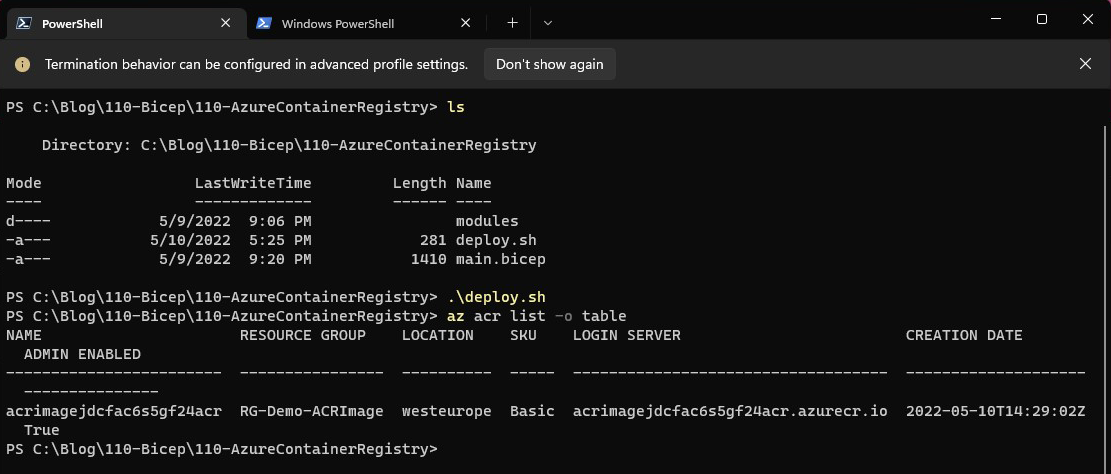
In my previous article , we went through the process of uploading our own image to Docker Hub. Even though it's perfectly fine to use Docker Hub, some organizations prefer using their own registries, either due to additional functionality that they might offer or due to policies and regulations. Since Azure offers a container registry resource that would fit most use cases, I thought we could try to upload some images and at least use it for test and dev purposes!  First things first, the tools we're going to need. To upload an image to an ACR we need: 1. An Azure Container Registry 2. Docker Desktop 3. Azure CLI Starting from the top of the list, we need the ACR resource to which we're going to upload the images. Clone my Github bicep repository and switch to the  ContainerRegistry-ImageUpload-001/110-Bicep/110-AzureContainerRegistry/ folder. Update the parameters in the deploy script and submit the deployment. The output should be similar to the below: If everything goe...

Upload your own image on Docker Hub

Image
One of the very first steps in the containerization process of a service or application is constructing the image that is going to be used for every component. A component may require a plain image that is just an Apache server, but in the majority of the cases, you'll have to add packages or apply configurations to the images already provided in Docker Hub. This will result in creating your own images that you may eventually share on Docker Hub.     In this post, we're going to follow the process of creating our own image and then publishing it. First, we need to decide the image on top of which we're going to build our own. To make this call, you need to know what services and applications are going to be running on your container. Take WordPress for example. You can start with the official image, one of the very popular Bitnami images, or with just a PHP-FPM image. In this example, we're going to build on top of the PHP Apache image and save all of our files in a dir...

Manage Docker Desktop using Powershell

Containers have been around for almost a decade and can now be considered as the de-facto approach to application development. From a test and development MySQL server to the most famous internet services like Google and Netflix, containers are the way to run modern applications. So, what is a container exactly? Containers are packages of software that contain all of the necessary elements to run in any environment. In this way, containers virtualize the operating system and run anywhere, from a private data center to the public cloud or even on a developer’s personal laptop. The number of persons that are using containers has skyrocketed in recent years, making Docker Desktop the major platform for running containers on Windows and macOS systems. Being a container user myself, I realized that a set of functions in Powershell would make my life a lot easier when it comes to the standard operations with Docker Desktop. I've put together all the functions that I needed at some point ...