Posts

Showing posts with the label Kubernetes

Controlling Network Access in AKS using Network Policies
Image
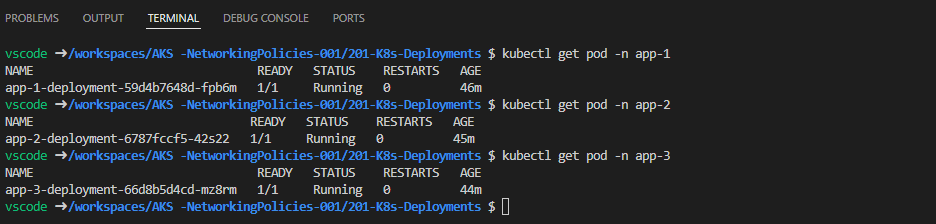
One of the very first problems when starting to deploy workloads in Azure Kubernetes Service is the segregation of the network. By default, all pods are part of the same network and can communicate with each other. In the majority of the cases, however, we want to restrict network access between pods, namespaces, applications, etc. Fortunately, K8s provide a way to easily control network traffic, called Network Policies . There are two types of policies that can be applied to a pod, Ingress and Egress. Ingress-type policies control the traffic inbound to the pod, whilst egress control the traffic outbound from a pod. In this post, we're going to work only with ingress-type policies since the configuration and principles are pretty much the same, it's just the direction that changes. To demonstrate the use of policies, we are going to be using three namespaces and each namespace will contain a deployment with containers that respond to ping requests and also contain the ping uti...

Publishing AKS services to private networks using NGINX

Image
In one of the previous posts, we used NGINX as the ingress controller in Azure Kubernetes Service, to publish applications and services running in the cluster (article is available here ). In that deployment, NGINX was using a public IP for the ingress service, something that may not be suitable for services that should be kept private or protected by another solution. In today's post, we're going to deploy NGINX in a way that the ingress service uses a private IP, from the same vNet that the cluster is built on top. Following the usual steps of logging in and selecting the subscription to use in Azure CLI, you just have to execute the deployment script that will deploy the main.bicep file and all of its sub-resources to create the AKS platform on Azure. The next step would be to get the credentials for the cluster using the  az aks get-credentials command, as shown in the getAKSCredentials.sh  script, in order to connect with using the kubectl tool. If you get the services ...

High Performance K8s Storage with Rook & Ceph

Image
Modern applications are usually developed with cloud-native principles in mind, there are however some that may have particular requirements in terms of storage. When developing for containers, the need for a ReadWriteMany storage may arise, which may turn into a problem when cloud services fail to match the requirements, especially the ones related to performance. One of the solutions to this problem is the Rook - Ceph combination. Ceph is an open-source software-defined storage platform that implements object storage on a single distributed computer cluster and provides interfaces for object-, block- and file-level storage. Rook, on the other hand, helps perform all the administrative tasks such as deployment, configuration, provisioning, scaling, and more. A multi-zone AKS cluster is the perfect home for Rook and Ceph. The cluster is spread across three data centers and so is the data handled by Ceph. This increases the SLAs of the services running on the cluster and at the same...

Using NGINX and Ingress Controller on Azure Kubernetes Service (AKS)

Image
In a Kubernetes cluster, the resources we deploy are assigned IPs from the cluster's network that makes them unreachable from other networks. The most common way to expose an app to the world outside the cluster is to create a service. The service will load balance the traffic across pods and will also bridge the gap between the two worlds (cluster and outside network) using a concept much like NAT. This, however, does now allow us control over how the app is published, from which pods, etc. This is where ingress controllers come into play. An ingress controller is a way to publish apps having full control on how each and every component is being accessed. Compared to traditional application deployment, we could say that the role and functionality of the ingress controller are much like those of application delivery controllers such as Citrix ADC and F5 BigIP.  The below diagram shows the basic functionality of an ingress controller: In this example, we have three namespaces config...